
She Who Wrote First: The Story of Enheduanna, The World's First Known Author
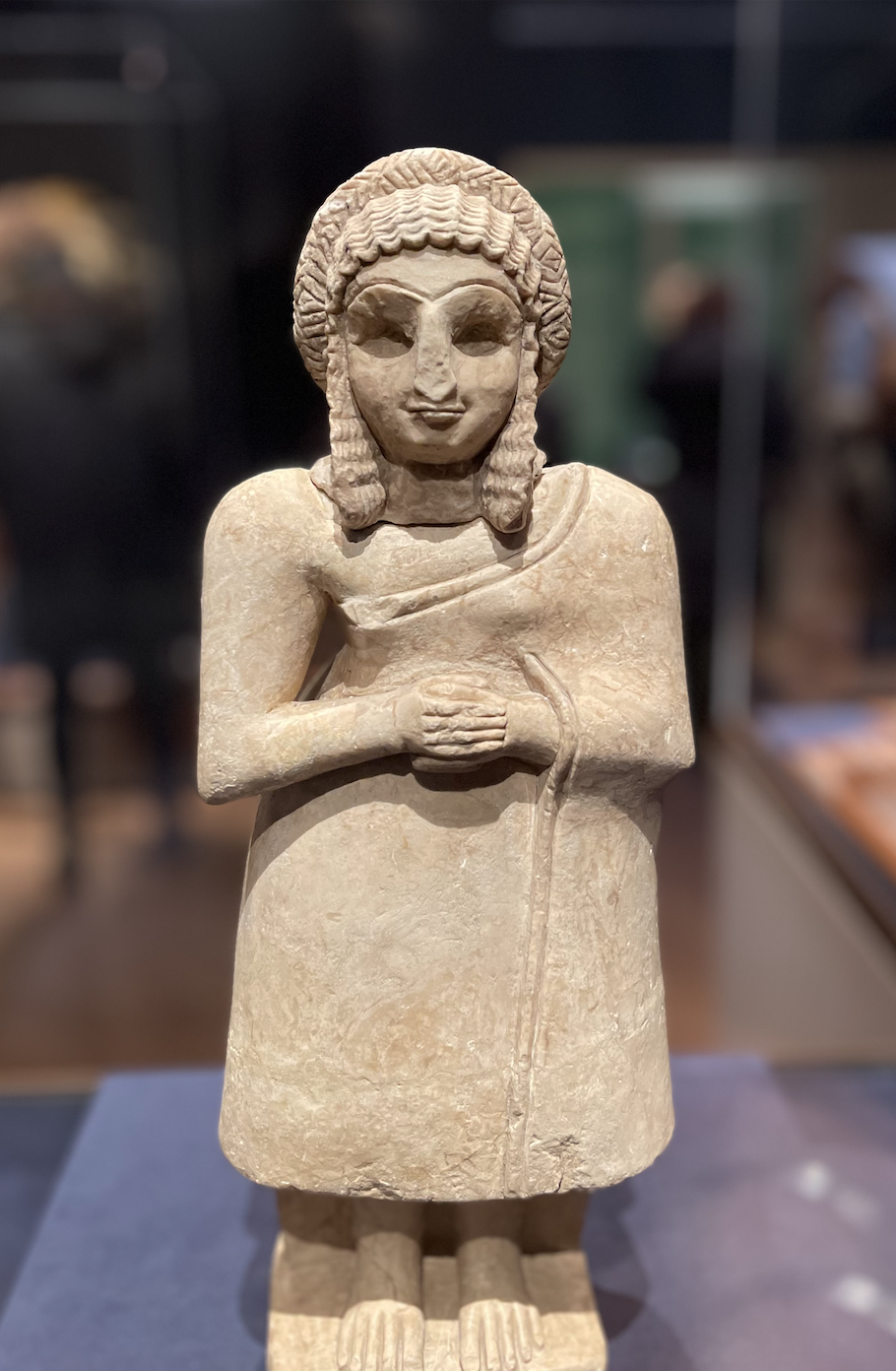
Standing female figure with clasped hands, Tutub (modern Khafajah), “Sin” Temple IX, Early Dynastic IIIa period, (2600-2450 BC,)Gypsum and shell, The Oriental Institute of the University of Chicago, excavated 1933/34; A12412.
Before Homer. Before the Bible. Before any name you were taught in school, there was Enheduanna.
And she was a woman.
Over 4,300 years ago, in ancient Mesopotamia (modern-day Iraq), a princess, high priestess, and poet named Enheduanna (pronounced: en-HEE-doo-AH-nah) picked up a reed stylus, pressed it into clay, and did something no one in recorded history had done before: she signed her name to her work.
She said: I wrote this. This is mine.
That single act, radical, defiant, and deeply spiritual, made her the world's first known named author in all of human history.
Most of us have never heard her name. And that is exactly why we need to talk about her.
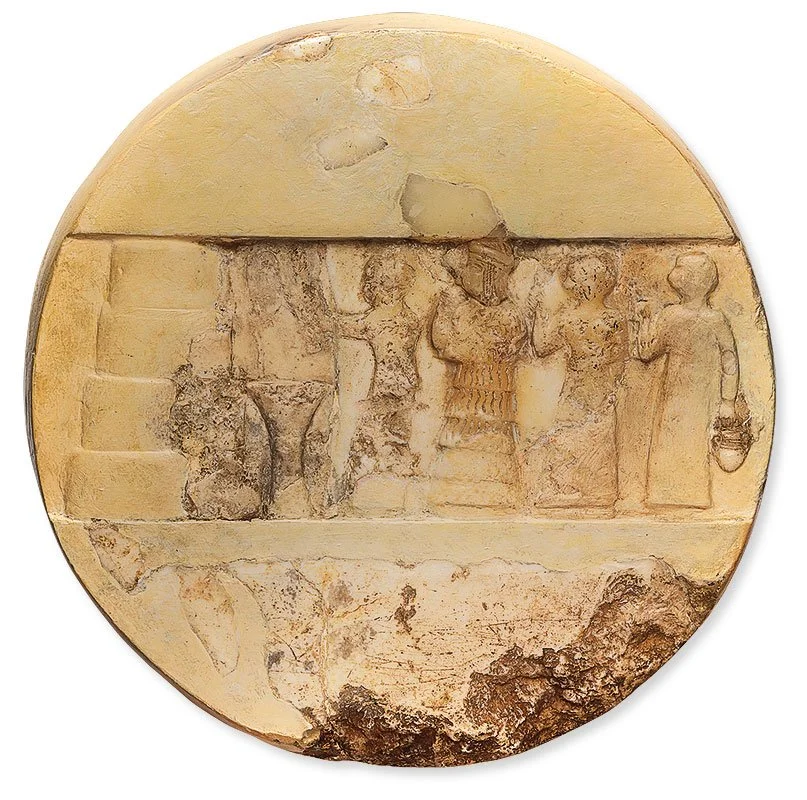
(above) Enheduanna, her Estate Manager Adda, her hairdresser Ilum Palilis, and her scribe Sagadu. Disk of Enheduanna, daughter of Sargon Mesopotamia, Akkadian, Ur (modern Tell el-Muqayyar), gipar Akkadian period, ca. 2300 BC Cuneiform inscription in Sumerian: En-h[e]du-ana, zirru priestess, wife of the god Nanna, daughter of Sargon, [king] of the world, in [the temple of the goddess Inan.
AlabasterUniversity of Pennsylvania Museum of Archaeology and Anthropology, Philadelphia, USA, Excavated 1926; B16665
Who Was Enheduanna?
Her name means "Ornament of Heaven" and she lived up to every syllable.
Born around 2285 BCE, Enheduanna was the daughter of Sargon of Akkad, the ruler credited with building the world's first great empire in ancient Mesopotamia. Her father appointed her as High Priestess of the moon god Nanna at the most important temple in Sumer, in the city of Ur. It was a role of immense spiritual, political, and cultural power and she held it for over forty years.
But Enheduanna was more than her title. She was an ancient "triple threat" not only a princess and a priestess but also a writer. A thinker. A woman who used her voice to reshape the spiritual landscape of an entire civilization.
She composed 42 temple hymns, two major hymns to the goddess Inanna, and deeply personal poems that reflected her own inner world: her fears, her faith, her fury. These weren't just religious formalities. They were literature. They were art. They were the beating heart of a woman who understood that words carry power.
At the end of her cycle of temple hymns, she wrote:
"The compiler of the tablets was En-hedu-ana."
She claimed her work. In a world that rarely let women be seen she made herself known.
While earlier works such as the Epic of Gilgamesh existed, their authors remain unknown. Enheduanna's voice has been recorded and preserved, making her the earliest author whose identity we can discover. But she was not merely the first to sign her name. She invented entirely new ways of speaking to the divine. New ways of structuring devotion. New ways of letting a human soul be fully, vulnerably present on the page.
What she created would travel further than she could have ever imagined.
She Inspired Your Sunday Morning
Here is the part that may make you need to sit down.
You know the Psalms. You have heard them in church, in gospel music, in prayer circles, from your grandmother's mouth. You have heard them sung, whispered, wept. They are arguably the most intimate, most personal, most emotionally raw writings in the entire Bible, a human soul crying out directly to the divine.
Enheduanna wrote that format first.
Scholars have confirmed that her compositions remained models of petitionary prayer for centuries, and that through the Babylonian tradition, they directly influenced and inspired the prayers and psalms of the Hebrew Bible. Petitionary prayer is personal, urgent, and vulnerable. It comes from a place of need. Such as: "Please help me." "Please heal me." "Please intervene." "Please see me in my suffering and respond." It is the most human form of prayer — a soul reaching toward the divine and saying I need you. As opposed to prayers of pure praise or thanksgiving, petitionary prayer is personal, urgent, and vulnerable. It comes from a place of need.
"Models of petitionary prayer" means:
Enheduanna essentially invented the template for how humans structure that kind of prayer in written form. The format she used; acknowledge the divine, describe your suffering, make your request, express faith in the outcome, became the blueprint that everyone after her followed. You can see that exact structure in the Psalms:
"My God, my God, why have you forsaken me?" — that is petitionary prayer
"Out of the depths I cry to you O Lord" — petitionary prayer
"Hear my prayer, do not turn away from me" — petitionary prayer
All of that emotional architecture, a human soul laid bare before God, asking to be seen, heard, and delivered?
Enheduanna wrote that first. For a goddess.
Her fingerprints are on the most read book in human history. And it does not stop there, faint echoes of her voice can even be heard in the hymnody of the early Christian church. Every gospel song. Every Sunday morning choir. Every devotional prayer lifted to heaven traces its literary roots back to a woman pressing a reed into clay, crying out to a goddess, 4,300 years ago.
And the bridge that carried her words there? The Babylonian exile.
After Israel's exile to Babylon, the ancient Hebrew songs and poems were gathered and arranged into what we now know as the Book of Psalms. The Hebrews spent generations living inside the direct cultural descendants of Sumerian and Akkadian civilization, the very world Enheduanna helped build spiritually and literarily. Her hymn structures. Her petitionary prayer format. Her raw, personal, first-person voice breaking open before the divine. It all traveled through Babylon and into Hebrew scripture.
This probably broke my heart the most: They took her words. Her prayer structures. Her raw, personal, feminine voice crying out to the divine…and they handed it to King David. They then would go on to burn women at the stake like Marguerite Porete (another woman you should know) for teaching people they could access that same divine/God directly. Without a male intermediary. The very thing Enheduanna had been doing 4,000 years before. Heart breaking isn’t it? The whole circle just closed. But this here, is an article for another time, I will circle back.
And there is one more thing.
The most sensual, mystical, feminine text in the entire Bible — The Song of Songs — comes closer than anything else in scripture to the passion and intimacy of Enheduanna's hymns to Inanna. A book that has confused and unsettled patriarchal theologians for centuries because of its unapologetic, embodied, feminine devotion. They didn't know where it came from.
Now you do.
The lineage flows like this:
Enheduanna (2285 BCE — priestess, poet, devotee of the divine feminine) -> Babylonian prayer and hymn tradition -> The Hebrew Psalms -> The early Christian church hymns -> Every gospel song, every choir, every prayer whispered in the dark
A woman. A priestess of the divine feminine. Writing to a goddess.
Is the foundation of Judeo-Christian worship.
And nobody taught us that. The whole world has been singing her song ever since, without ever knowing her name.
For further reading:
World History Encyclopedia — Enheduanna (worldhistory.org/Enheduanna)
The Book of Psalms — Bible Project (bibleproject.com/guides/book-of-psalms)
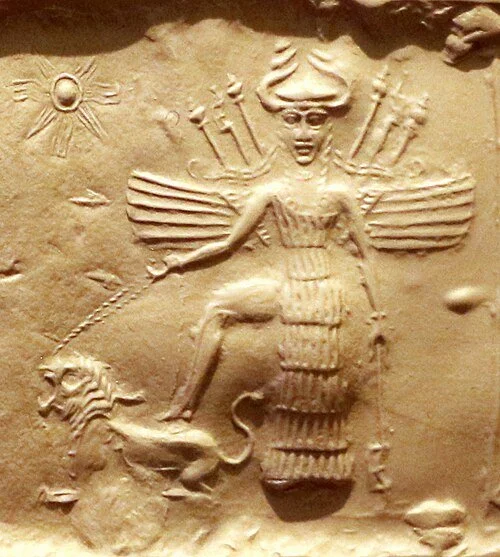
The Goddess She Honored
Enheduanna's most celebrated writings were devoted to Inanna, the Sumerian goddess of love, war, beauty, and sovereignty. Inanna would later be known as Ishtar in Akkadian tradition, and her energy lives on in Aphrodite, Astarte, and countless other expressions of the divine feminine across cultures and centuries.
In honoring Inanna, Enheduanna wasn't just writing hymns. She was preserving the feminine face of the divine, of God at a time when empires were being built on conquest and consolidation. She was saying: the goddess is real, the goddess matters, and I will not let her be erased.
Her three most famous works, The Great-Hearted Mistress, The Exaltation of Inanna, and Goddess of the Fearsome Powers, redefined how an entire empire understood its relationship to the sacred.
That is not a small thing. That is legacy.
A Hymn to Innana:
“My lady, …… mercy …… compassion …… I am yours! This will always be so! May your heart be soothed towards me! May your understanding …… compassion. May …… in front of you, may it be my offering. Your divinity is resplendent in the Land! My body has experienced your great punishment. Bitter lament keeps me awake with …… anxiety. Mercy, compassion, care, lenience and homage are yours, and to cause flood storms, to open hard ground and to turn darkness into light.”
She Was Holding the Line
Here is the part that will give you chills.
When Enheduanna was writing her hymns to Inanna, fiercely, personally, with her name pressed into clay, she was doing it at the exact moment the world was beginning to shift beneath her feet.
In the earliest Mesopotamia, the divine feminine wasn't just present. She was dominant. The oldest records show that female deities, Inanna, Ninhursag, Ninkasi, Gula, were worshipped more widely than male gods. Women in this period could own land, run businesses, sign legal contracts, serve as judges, doctors, and priests. The goddess was honored, and so were her earthly reflections. (To think this region is present day Irag, Afghanistan and Pakistan, where women’s rights are now completely obliterated. )
But by Enheduanna's era, that was already beginning to erode.
Each successive empire — Akkadian, Babylonian, Assyrian — chipped away further. With every shift in power, the goddess was pushed lower in the pantheon, and women's rights followed. Scholars have noted that this is not a coincidence: the suppression of the divine feminine in religion and the suppression of women in society move together, always. As the gods replaced the goddesses at the top of the spiritual hierarchy, women lost ground in every other domain of life.
By the time of the Assyrian Empire, women were considered property. The Assyrians were among the first civilizations to impose veiling, only free women were permitted to cover themselves, marking their "belonging" to a man. The sacred Qadishtu women and powerful priestesses of earlier Sumer had been replaced by women who could be legally stripped of everything they owned.
And centuries later, after the fall of the Sassanian Empire in 651 CE, the final and most dramatic collapse of women's rights in the region occurred, a blow from which, in many ways, that part of the world has yet to fully recover.
Enheduanna was writing at the turning point. She was more than a poet and this is clear. She was a keeper of something that was being threatened. Every hymn she wrote to Inanna, goddess of love, war, and sovereignty, was an act of preservation. A refusal to let the feminine face of the divine be forgotten.
She was holding the line. And she knew it.
She Survived, and She Kept Writing
Enheduanna's life was not without violence. During a rebellion, she was forcibly removed from her position as high priestess. By her own account, she endured profound trauma during that time.
And yet… she wrote through it.
She returned to her temple. She reclaimed her role. She kept pressing words into clay until her voice became one of the most preserved in all of ancient history.
Her work was so powerful, so enduring, that scribes were still copying her hymns 500 years after her death. Scholars have compared this to the way the oldest surviving copy of Ovid's Metamorphoses dates to about a millennium after he lived, yet no one questions his authorship.
Her resilience is ancestral medicine. Her story is a blueprint.
In her poem The Exaltation of Inanna, she tells the story of being driven from her post as high priestess and cast into exile. She writes a plea for help to the goddess Inanna requesting her to petition the god An for help:
“Funeral offerings were brought, as if I had never lived there.
I approached the light, but the light scorched me.
I approached the shade, but I was covered with a storm.
My honeyed mouth became scummed. Tell An about Lugal-Ane and my fate!
May An undo it for me! As soon as you tell An about it, An will release me.”
Inanna apparently heard her prayer and, through divine intercession, Enheduanna was finally restored to her rightful place in the temple. She seems to have been the first woman to hold this position in Ur and her comportment as high priestess would have served as an exemplary model for those who followed her.
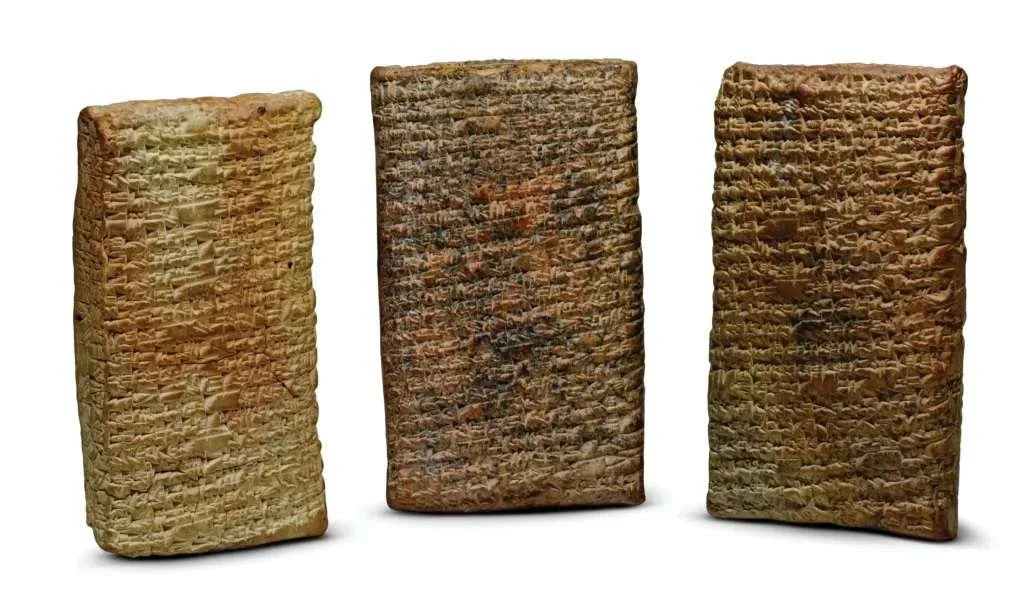
Tablets inscribed with ‘The Exaltation of Inanna’ in three parts, possibly from Larsa (Iraq). Clay, Old Babylonian period, c.1750 BC. Size: 9.7 x 5.9 x 3.1cm each. (Image: Courtesy of the Yale Babylonian Collection. Photography by Klaus Wagensonner)
Why Was She Erased?
Here is the part we have to sit with.
Enheduanna lived in Mesopotamia, a region that would go on to become one of the most deeply patriarchal areas in human history. The suppression of the feminine in that part of the ancient world is not coincidental. The very place where a woman first put her name on words is also the place where women's voices, over centuries, became among the most silenced on earth.
Her existence was rediscovered only in 1927, when British archaeologist Sir Leonard Woolley uncovered the Disk of Enheduanna: an alabaster relief bearing her image and her name, buried in the ruins of Ur. It took decades more before scholars began taking her authorship seriously.
Some still debate it. They ask whether a woman could really have written work that powerful. SMH.
She answered them 4,300 years ago though. Her name is on the tablet. SHE SAID WHAT SHE SAID, PERIOD.
The erasure of Enheduanna from history is not separate from the broader erasure of the divine feminine that has been actively taking place in the world for centuries. It is the same story. The same pattern. A woman who elevated the goddess, who claimed her own voice, who refused anonymity, buried under thousands of years of empire, conquest, and a world that kept rewriting itself with men at the center.
But here is what they could not destroy: the tablets survived. Her words survived. And now, in this moment in this era of remembering and reclaiming …so does she.
What Her Story Means for Us
At Dalai Mama, we believe that ancestral wisdom and modern liberation are not separate paths, they are one.
Enheduanna is proof that women have always been the originators. The healers. The keepers of spiritual knowledge. The ones who named the sacred and refused to let it be forgotten.
She didn't wait for permission to be an author. She didn't wait for the world to make space for her voice. She created a form, poetry, hymn, devotional literature and gave it to the world. Entire genres of writing that still exist today trace their roots back to her reed and her clay.
When we talk about returning to our roots, when we talk about ancestral wisdom, when we talk about the divine feminine, we are, whether we know it or not, talking about a lineage that runs through women like Enheduanna.
She wrote first. She signed her name. She made sure we would one day find her.
Now it's our turn to make sure the world remembers.
She Who Wrote
This Women's History Month, we invite you to say her name:
En-hee-doo-AH-nah.
Tell someone about her. Share this post. Let her legacy travel further than the cuneiform tablets could carry it.
Because that is what she would have wanted, not to be a footnote in someone else's story, but to be known. Fully. In her power. As the first.
The world's first author was a woman. A priestess. A survivor. A devotee of the divine feminine.
She started something 4,300 years ago.
We're still continuing it.
✨ Share this story. Say her name. Keep the lineage alive.
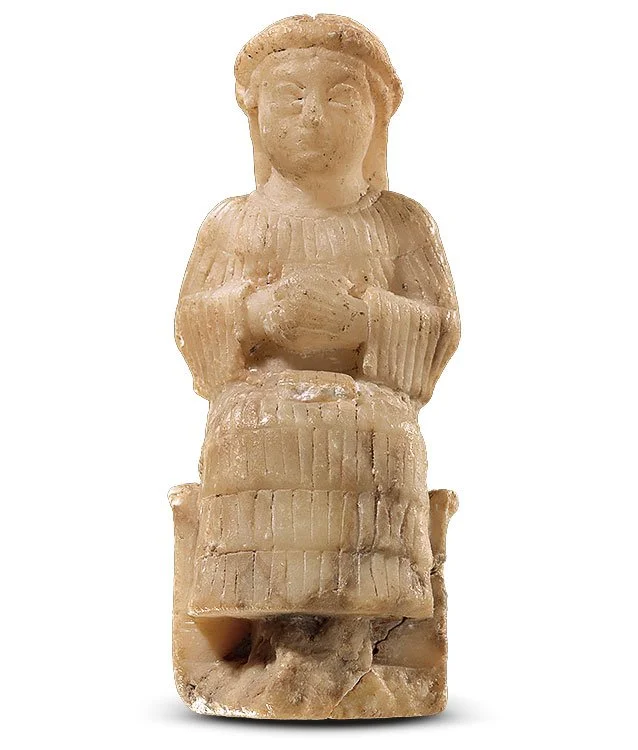
Seated female figure with tablet on lap
Mesopotamia, Neo-Sumerian
Ur III period (ca. 2112–2004 BC)
Alabaster
Staatliche Museen Zu Berlin, Vorderasiatisches Museum, Acquired 1913; VA 04854
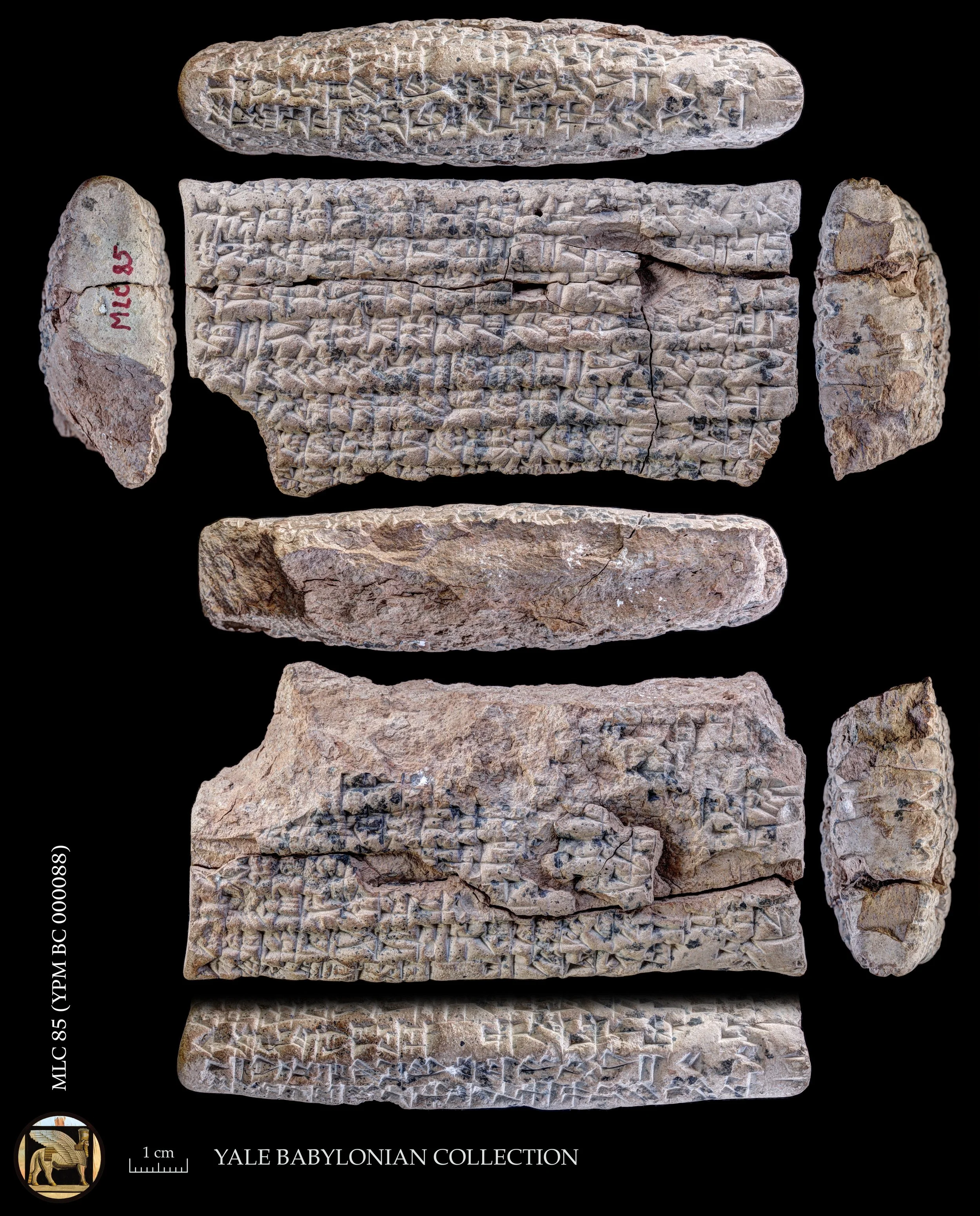
Tablet. Enheduanna B - hymn to Inanna as in-nin $a3-gur4-ra (ll. 14-31). Old Babylonian. Clay. Yale University Babylonian Collection
