
Ancestral Wounds and the Science of Epigenetics: What Your Body Inherited and How to Begin Clearing It
There is a particular kind of pain that doesn't have a story. A grief too large for your own life to account for. An anxiety that predates any experience you can point to. A hypervigilance that lives in your body like a permanent resident you never invited in.
For a long time, these experiences were dismissed as psychological, behavioral, or simply character. What emerging science is now confirming is something ancestral traditions have always known: some of what you carry isn't yours. It was handed to you through your lineage, encoded in your biology before you took your first breath.
What Epigenetics actually says
Epigenetics is the study of changes in gene expression that don't alter the DNA sequence itself but determine whether certain genes are switched on or off. What makes this field significant for ancestral healing work is the discovery that these changes can be passed from parent to child, meaning the environmental conditions your ancestors survived can leave biological marks that show up in your body generations later.
The most cited research in this area comes from Dr. Rachel Yehuda at Mount Sinai Hospital, whose work with Holocaust survivors and their descendants documented measurably different cortisol profiles and stress hormone regulation in people who never personally experienced the original trauma. The biological signature of what their parents and grandparents survived was present in their bodies without shared experience.
The research specific to descendants of enslaved Africans which lacks funding for continued research something worth mentioning. A 2018 study published in the Journal of Clinical Epigenetics by Jackson, Jackson, and Jackson documented that the conditions of enslavement, capture, forced migration, torture, chronic food deprivation, forced labor, and the sustained terror of institutionalized racism, produced measurable epigenetic changes with enduring multigenerational impact. Elevated cortisol levels. Disrupted stress responses. Altered nervous system regulation. Biological evidence of inherited trauma running in the bodies of descendants who never personally experienced the original wound. Dr. Joy DeGruy, social work scholar and researcher, named this phenomenon Post Traumatic Slave Syndrome, a framework that accounts for the psychological and behavioral patterns present in African American communities as adaptive survival responses to centuries of trauma that have never been fully acknowledged, processed, or healed.
The California Legislative Assembly formally recognized this in 2018, passing a resolution acknowledging that ancestral trauma from both the enslavement of African Americans and the genocide of Native Americans is encoded at the molecular level, that the DNA of descendants carries the traumatic history of their ancestors. THIS IS BIOLOGY FOLKS!
Why this research remains underfunded
It is worth saying plainly: the gap between what is known and what has been formally studied and funded reflects whose suffering has historically been considered worth investigating. The Holocaust epigenetics research is extensively documented. The research on descendants of the Transatlantic Slave Trade, which involved a longer duration, larger numbers, and arguably more total dehumanization, unfortunately remains comparatively sparse. Which speaks to a larger systemic issue doesn’t it?
The mechanism of transgenerational epigenetic inheritance does not discriminate by which atrocity produced the trauma. The relative absence of research is a resource and priority problem, not an evidence problem. For communities whose ancestral wounds remain both biologically active and politically unacknowledged, this distinction matters.
Where It Lives In The Body
Understanding that ancestral trauma is biological rather than purely psychological changes what healing has to look like. Bessel van der Kolk's foundational research, documented in The Body Keeps the Score, established that trauma is stored in the nervous system, muscles, and tissue, not only in memory or cognition. This applies to inherited trauma as much as personally experienced trauma.
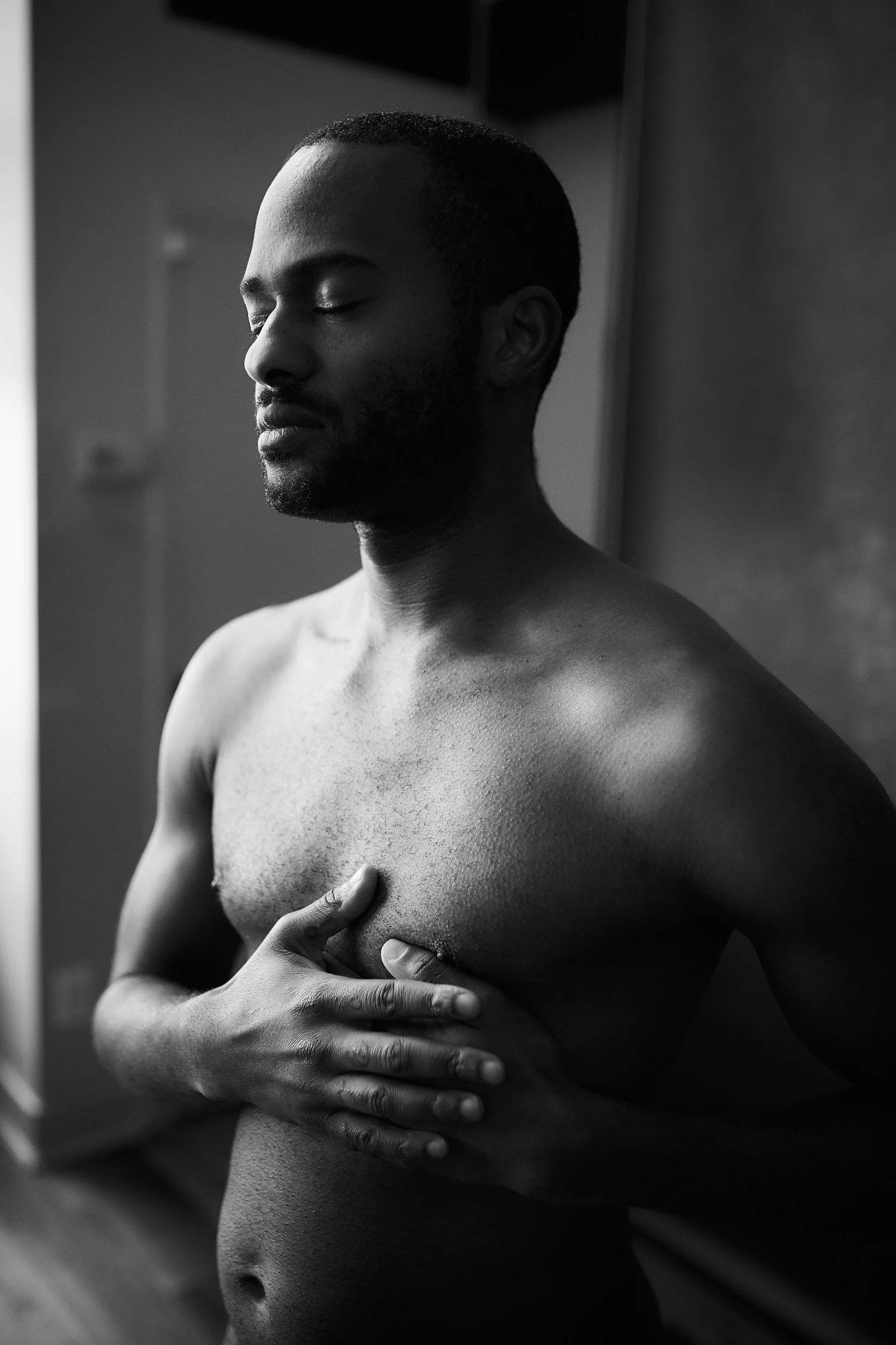
Ancestral wounds have specific somatic addresses. Survival trauma, the fear, hypervigilance, and scarcity that comes from generations of displacement, enslavement, and institutionalized violence, it tends to live in the root center and the lower body. Sexual and reproductive trauma, including the particular violations of enslaved women whose bodies were owned and used without consent, lives in the sacral center and the hips. Collective grief, for lost names, lost languages, lost homelands, lost children, lives in the heart and the chest.
You cannot think your way out of what is stored in tissue. This is why intellectual understanding of ancestral trauma, while necessary, is not sufficient for healing. The body has to be part of the work.
What the Clearing Actually Requires
Ancestral clearing is slower and more layered than personal cord clearing. The material is older, more systemic, and more deeply embedded. It clears in layers over time through multiple approaches working simultaneously.
Naming. The first and most powerful act is naming the pattern as ancestral rather than personal. "This hypervigilance is not a character flaw. It is a survival adaptation my ancestors developed and my body inherited." The naming creates the distance needed to relate to the pattern rather than be defined by it. This alone begins to shift the nervous system's relationship to the material.
Somatic practice. Because ancestral material lives in the tissue, it must be moved through the body. Breathwork, particularly extended exhales, it activates the parasympathetic nervous system and discharges stored emotion from the nervous system. Hip-opening movement and shaking practices move material stored in the lower body. Ritual herb baths using rue, used across African diasporic and Latin traditions for energetic clearing and protection, and mugwort, associated with ancestral communication across multiple traditions, address the energetic field alongside the physical body. These are not supplemental practices. They are the delivery system for what the mind alone cannot reach.
Ancestral communication. Speaking directly to those who carried the wound before you is a practice present across virtually every earth-based tradition precisely because it works. Not to expel the ancestors or sever the connection, but to witness what they survived and consciously declare that you are completing what they could not. I see what happened to you. I see what you couldn't finish. I am finishing it. You can rest. This act of witnessing releases the cord on both ends, in the living and the ancestral.
Breaking the behavioral loop. Ancestral wounds are maintained in the present by repeating the patterns they encode. Every time you choose differently, every time you rest instead of overworking, receive instead of only giving, stay instead of fleeing, speak instead of swallowing, you are performing ancestral healing. The behavioral interruption is not just therapeutic. It is the living completion of what the lineage couldn't finish.
What This Means Beyond The Personal
Ancestral healing work is not only personal work. When you clear a pattern that your mother carried, and her mother carried before her, you heal backward and forward simultaneously. The children who come after you, born or unborn, receive a different field. A different biological inheritance. That is the actual stakes of this work.
For communities whose ancestral wounds have been simultaneously active and unacknowledged, whose trauma was never formally witnessed, whose reparations were never made, whose science was never funded, the healing work carries an additional weight and an additional power. You are not only healing yourself. You are completing centuries of interrupted healing on behalf of a lineage that survived everything it faced.
That survival is the inheritance too. The resilience, the creativity, the spiritual depth, the capacity to find beauty and make culture in conditions designed to destroy, that also lives in the biology. The wound and the gift traveled together.
The work is to clear enough of the wound that the gift can finally move freely.
References
DeGruy, J. (2005). Post Traumatic Slave Syndrome: America's Legacy of Enduring Injury and Healing. Uptone Press.
Jackson, F., Jackson, L., & Jackson, Z.E. (2018). Developmental stage epigenetic modifications and clinical symptoms associated with the trauma and stress of enslavement and institutionalized racism. Journal of Clinical Epigenetics, 4(11), 1–7.
Jasienska, G. (2009). Low birth weight of contemporary African Americans: An intergenerational effect of slavery? American Journal of Human Biology, 21, 16–24.
Kuzawa, C.W., & Sweet, E. (2009). Epigenetics and the embodiment of race: Developmental origins of US racial disparities in cardiovascular health. American Journal of Human Biology, 21, 2–15.
van der Kolk, B. (2014). The Body Keeps the Score: Brain, Mind, and Body in the Healing of Trauma. Viking.
Yehuda, R., Daskalakis, N.P., Bierer, L.M., Bader, H.N., Klengel, T., Holsboer, F., & Binder, E.B. (2016). Holocaust exposure induced intergenerational effects on FKBP5 methylation. Biological Psychiatry, 80(5), 372–380.
California Legislative Assembly. (2018). Resolution ACR 110: Intergenerational trauma and epigenetic study. Author: Representative Reginald Jones-Sawyer.
HeartMath Institute. (2015). Science of the Heart: Exploring the Role of the Heart in Human Performance. HeartMath Institute Research Center.
